I cannot tell you how many times I have tried to write about this in any sort of succinct way. Every single time, words fall short. Perhaps one day I will succeed in telling this story, but for now, here goes attempt number 856069:
You know when you’re on an airplane, in turbulence, and the overhead bins start to shake, and everything starts to shake, and suddenly the plane plunges for a moment and it feels like nothing is beneath you, holding you aloft? And even though you know the thing can fly and aerodynamics will keep you safe (you’re good at pushing from your mind the many plane failures you’ve heard of), part of you is afraid the plane will break into a thousand pieces and you’ll find yourself with nothing solid under your feet, falling to your death, gasping in vain for lungfuls of air?
Last summer, it was my life that started to shake with a turbulence I’d never experienced before. My plane did crack apart, and it was the most terrifying, vertiginous thing I have ever undergone. But it was also the most miraculous. I found a well of bravery and boldness I didn’t know I possessed. Instead of free-falling, I discovered I’d never needed a plane to begin with.
I was a fucking dragon.
“For a seed to achieve its greatest expression, it must come completely undone. The shell cracks, its insides come out and everything changes. To someone who doesn't understand growth, it would look like complete destruction.Cynthia Occelli
The above is all so vague as to be useless, but if you’ve ever gone through intense personal life changes, perhaps you can relate to the sentiment. Often, I really am only capable of talking about all of this in metaphors. I shall try to keep it more direct. In more practical speak: Tyler and I had a rough couple of years of what-in-the-hell-are-we-doing-with-our-lives stress. Our spirits were stretched to their breaking points, beginning to fray from the friction of two very different humans wanting very different things in life but being devoted to one another nonetheless.
Finally, last summer / fall everything came to a head and my "plane” shattered into a thousand tiny pieces. And then, thanks to my world crumbling apart, something beautiful and miraculous happened: I stumbled upon the reality that I’m gay.

There are enough stories and insights contained within the paragraph above to fill a book, but that will have to do for now.
After months of navigating our brave new world, it quickly became clear that “Husband” and “Wife” just weren’t accurate descriptors for the shape of our relationship. It felt wrong to keep them. So, Tyler and I separated. We also got matching bike chain grease tattoos and went on a motorcycle trip.
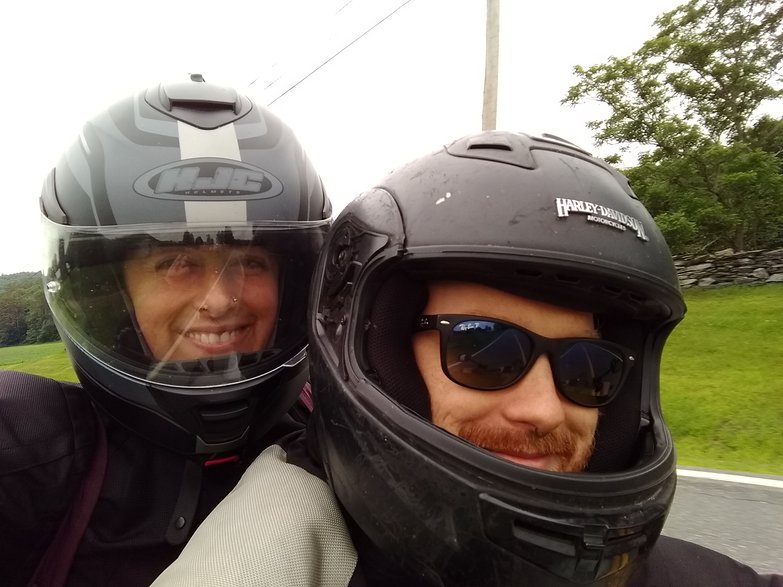
We remain family, BFFs, memory-keepers, partners in business and life, adventure buddies, and champions of each other living our best lives. When you’ve experienced and created as much as Tyler and I have together, you never stop loving each other, you never stop your story. You just boldly change it. You keep the good parts, and Konmari the bejesus out of everything else. Which, to be honest, is always how we’ve rolled.
Life is too short for anything else.

I moved an hour east of the homestead to be near the woman I love: Erin, heart of my heart. She’s got eyes that shine with starlight, a laughter of bells, a smile that lights my world. She’s my cloud-admirer and veery-finder, my balm and my catalyst. The woman with whom I want to dance through life, zipped back together like Plato’s halves.

Tyler helped me pack.
If he hadn’t, I really don’t know if I’d ever have summoned the courage to be brave enough to do what needed to be done to heed the hollering of my heart. Biking around the world, living in a trailer through two Vermont winters, building a house by hand, flying into the sky on what is effectively a go-cart, and learning to breathe underwater...these activities all required courage.
But this was nothing, nothing compared to the bravery required to be honest enough with myself to admit that I had to change the shape of our relationship.

The amount of gratitude I have for him knows no bounds.

I wish I could say this transition was a purely joyful one, but that would be a massive lie. This past year was fraught with screaming fights and last straws, and more tears than I can count. But there was also such tenderness, understanding, and deep love for one another that I still can’t fathom how I got to be so lucky.

Meanwhile, Erin’s and my relationship is complex in a way I never believed I’d be capable of navigating. In many ways, it feels like the past year was training so I’d be able to be with her. Actually, it feels like the past eleven years were training. Tyler and I were each other’s rock tumblers, so we could finally crack each other open to be the people we were meant to be.

I wouldn’t say life is easy now, but I am thriving and happy. Standing on my own two feet, flying with my own two wings, more at home in my own skin than I’ve ever been.
Barn's burnt down / now I can see the moon.Mizuta Masahide
